
Key Takeaways: Your Secret Weapon For Content Performance

Many enterprises assume their content underperforms because it is not attracting enough attention. But as Knotch explored in our latest workshop, a lack of traffic is often not the real problem. More often, the issue is that content does not give visitors a compelling reason to continue their journey with the brand. In other words, most content doesn’t fail because it lacks traffic. It fails because it goes nowhere. That is why recirculation rate has become one of Knotch’s favorite metrics.
Put simply, recirculation rate measures whether a piece of content successfully moves someone from one page to another within a brand’s site. It is the opposite of a dead end. And according to David Brown, SVP and Head of Strategy at Knotch, it is also one of the clearest signals that content is helping drive conversion.
“Recirculation rate correlates very closely to conversion rate,” Brown said. “If your recirculation rate goes up to 35 to 40%, your conversion rate multiplies by six.” This finding from Knotch is based on a study of engagement and conversion across 18,500+ pages from eight B2B and B2C brands.
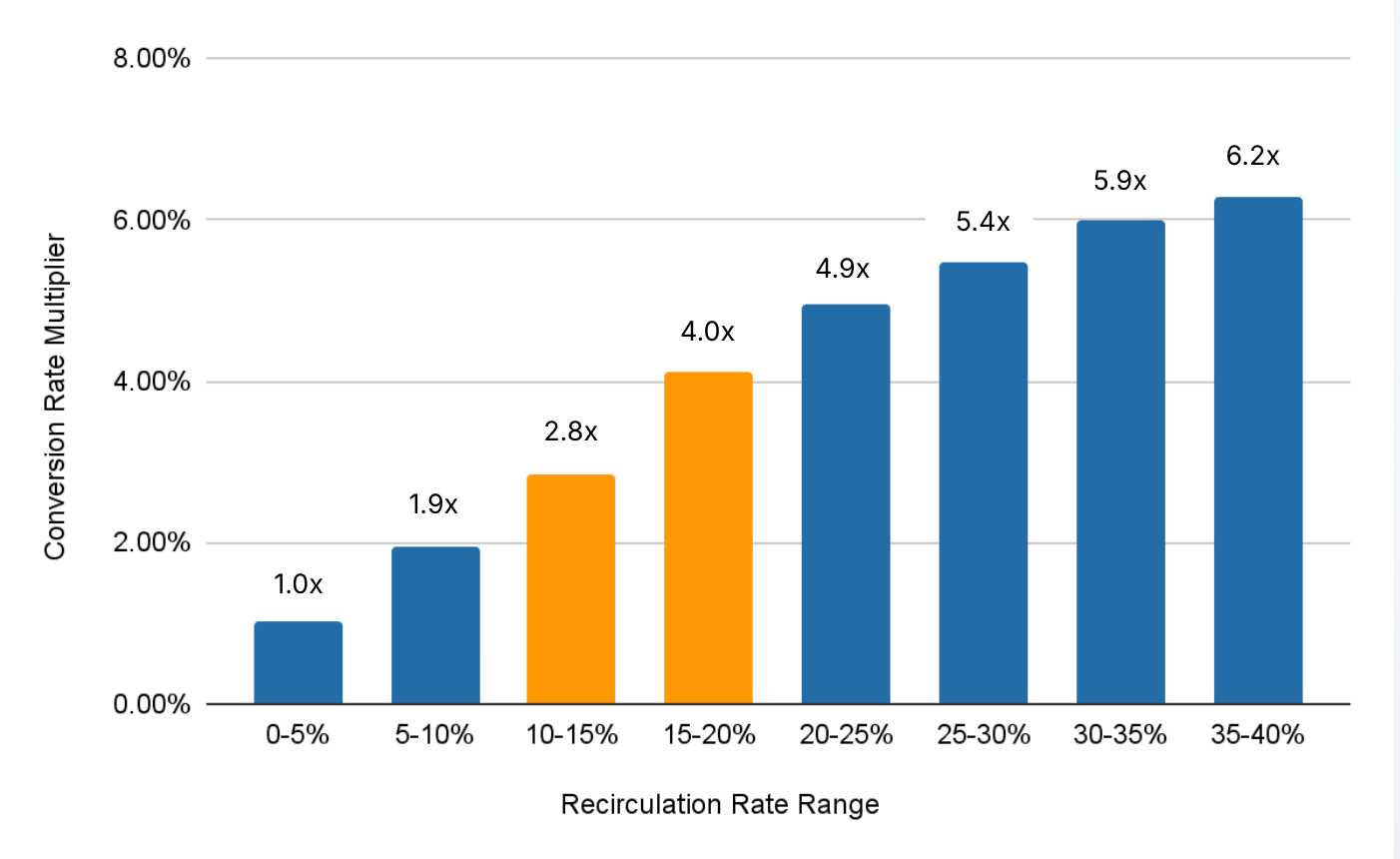
Recirculation rate is not just an engagement metric – it is a measure of whether your content creates forward motion.
What are the best ways to optimize for a high recirculation rate? In this month’s workshop, Brown was joined by Knotch’s own Keith Wiegold, Erin Malloy, Tommy Shaker, and Landon Cowan to unpack what the metric really reveals about content performance — and how marketers can improve it. Their discussion moved from strategy to UX to testing, offering an accessible road map for brands that are looking to turn their websites into highways of journey progression rather than content cul-de-sacs.
Here are the biggest takeaways.
1. Recirculation is a measure of relationship-building
Keith Wiegold, Sr. Director of Content Strategy, opened the session by reframing recirculation as a journey metric, not just a page metric.
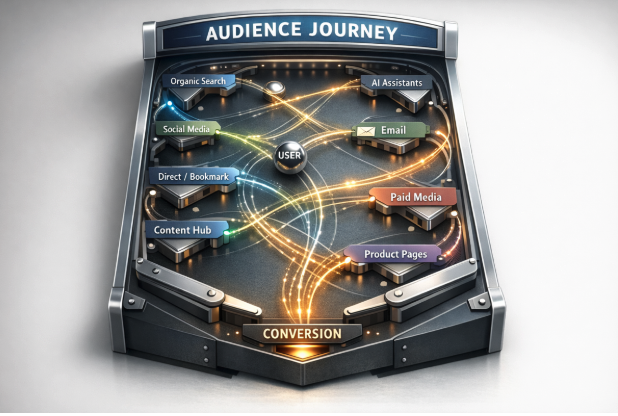
Whether a brand uses a three-stage funnel or a far more complex model, Wiegold argued that one truth remains constant: Audiences, not marketers, control the buyer journey. They may arrive from traditional search, AI-enhanced search, LLMs, paid channels, or social. They may be ready to move forward immediately when they land on a brand’s website, or they may still be figuring out whether they even have a problem to solve. That is why content has to support movement without forcing it.
“When you try to push a prospect too quickly to that conversion point deeper into the overall journey, that’s where we see things leading to drop-off,” Wiegold said.
In other words, recirculation does not always mean pushing someone to the next funnel stage. Sometimes it means helping them stay in the same stage long enough to build understanding and trust. A reader who clicks into another relevant article, tool, or guide is signaling their interest. They are deepening their engagement with the brand. And that deepening is what makes later conversion more likely.
Wiegold also emphasized the role of narrative themes in supporting that process. Rather than publishing disconnected one-off assets, brands should create coherent narratives that help audiences continue learning over time. Episodic content, blog series, podcast formats, and themed content hubs all create natural reasons for audiences to keep going.
“Recirculation is a deepening with the audience through their journey with your brand.”
2. Low recirculation is a symptom, not a diagnosis
One of the workshop’s particularly resonant ideas came from Landon Cowan, Group Account Director, Strategy. He urged marketers not to misread low recirculation as a simple content failure.
“Low recirculation, it’s important to note, is a symptom,” Cowan said. “This is not a verdict.”
In his view, weak recirculation usually points to one of three problems:
- It could be the content itself. Maybe the content did not answer the question a visitor actually had.
- It could be the user experience around it; say, the page design created a dead end.
- It could be the journey map behind the page. The brand may have misjudged what stage the visitor was in, and served the wrong next step.
This distinction is important because teams often respond to poor performance with activity rather than diagnosis. They rewrite copy, produce more assets, or change formats without first identifying what actually broke.
Cowan recommended going back to the journey first: What is the visitor thinking, feeling, and trying to accomplish at that moment? What needs to be true for them to take the next step? Once teams answer those questions, they can build hypotheses, prioritize them by likely impact and effort, and document them in a clear brief.
He detailed a case study from Knotch in which a brand launched a campaign for a highly specialized, high-cost product. Traffic and engagement looked strong, but recirculation was nearly nonexistent. The brand’s instinct was to revisit the content. But when the team re-examined the journey, they realized the real problem was stage mismatch: The page assumed that visitors were ready to evaluate the product, when in reality they were still in curiosity mode.
The solution they worked on with Knotch was not more content for the sake of content. It was content that answered the question visitors actually had: “Is this even for someone like me?”
“Once we accepted that reality, everything improved,” Cowan said.
3. Better CTAs can dramatically improve journey progression
Erin Malloy, Director of Content Strategy and Analytics, made a compelling case that if recirculation is the goal, calls to action deserve much more attention than most brands give them. This is often a design or copy issue. Page layout, CTA placement, and CTA phrasing all play a major role in whether visitors continue their journey or leave the site.
Malloy showed how a strong page layout supports recirculation from the moment a visitor lands. That can mean related-content modules for visitors who realize they need something slightly different, embedded links throughout the body text, sticky or evolving sidebar modules, and bottom-of-page recommendations for readers ready to continue. The key for a brand is intentionality: knowing who the reader is, what they likely need at that moment, and where the next-step opportunity should appear.
“The placement of these CTAs on the page matters a lot,” she said.
She also drew an important distinction between generic and contextualized CTAs. A generic CTA may align with the site’s ultimate business goal, but if it could appear on any page on the brand’s site versus that specific one, it is probably too broad to do its job well. A stronger CTA reflects the specific content someone is consuming and offers the next logical step based on that context.
Her rule of thumb was simple and useful: “If your CTA could live anywhere on the site, it’s probably not doing its job.”

Malloy pushed this further into personalization. When brands know more about the visitor – whether through behavior, audience segment, or referral context – they can serve more relevant next steps. But even without a sophisticated personalization engine, brands can still approximate personalization by thinking honestly about who is most likely reading a given page and what that person needs next.

She shared a particularly telling example from the mortgage space. A high-traffic, high-engagement article about home equity loans had a very low recirculation rate. Why? Because the most prominent CTA on the page invited readers to “take the first step to buying a home,” even though someone reading about home equity loans is likely already a homeowner. The content and the CTA were aimed at different people. The fix was obvious once the mismatch was spotted.
For brands looking for a lower-lift, high-impact optimization, Malloy suggested starting here: examine the CTAs on your highest-traffic pages “with a really judgmental eye.”
4. Drop-off behavior can tell you exactly what visitors still need
Tommy Shaker, Manager of Value Delivery, brought the conversation into the world of data and journey analysis. Through this lens, recirculation can reveal not only whether content is working, but what visitors are looking for when it is not.
His core point was that when someone steps off the path a brand has designed, that behavior is informative. If they do not leave the site entirely, but instead branch off to another page, that is evidence they still need something that was missing from the intended journey.
“That tells us that they are looking for additional information or different information from what you’ve provided,” Shaker said.
This is where drop-off analysis becomes so valuable. By looking at where visitors go when they abandon a planned pathway, brands can learn what information they need to add upstream to make the journey more efficient. This can be anywhere – in landing pages, campaign content, or content modules.
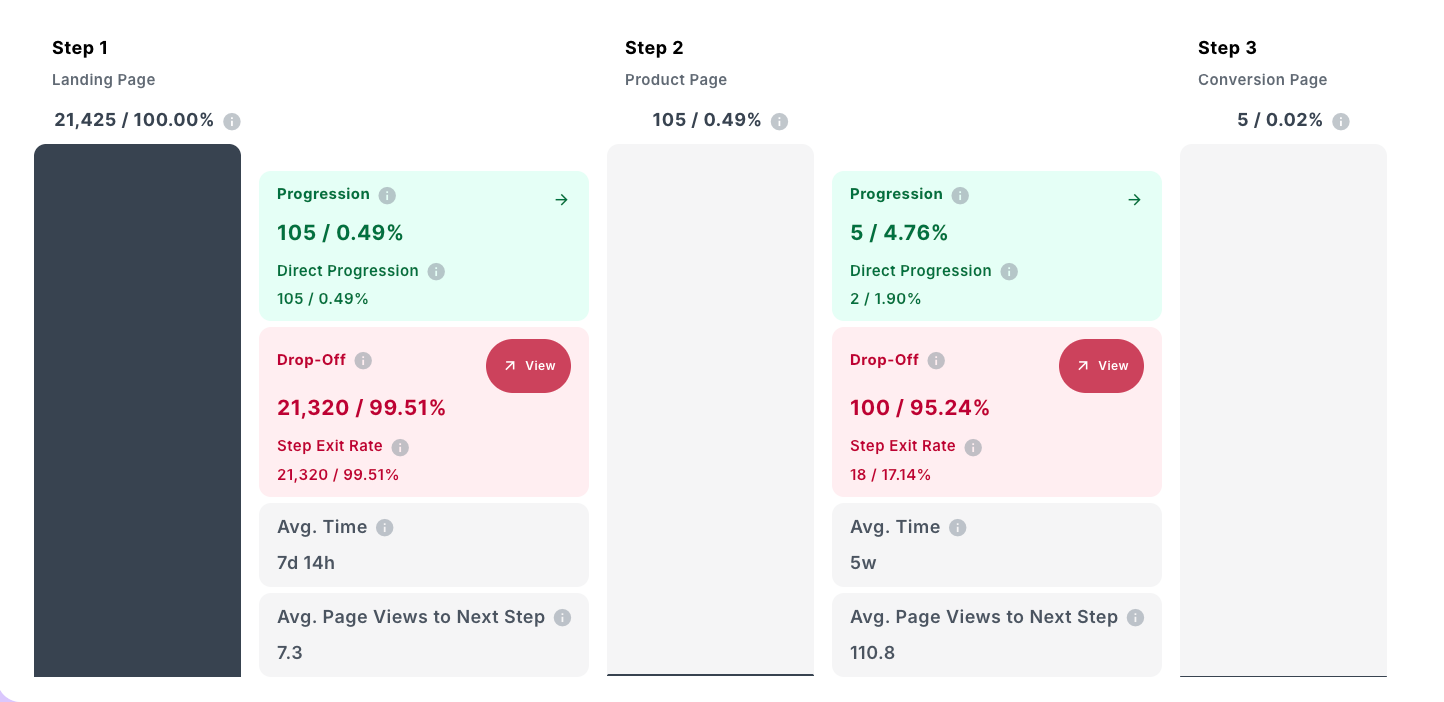
One client example that Shaker cited centered on pricing. Although visitors to the brand’s site could not receive exact pricing without contacting sales, many still navigated to the pricing page before taking that next step – and when they couldn’t find what they needed, they dropped off. That behavior showed that general pricing information, even if incomplete, helped people feel more comfortable progressing toward conversion. Once the team understood that, they could better incorporate pricing context into earlier touchpoints.
Shaker’s point reinforced a broader theme across the workshop: The more granular the analysis, the more precise the optimization. Recirculation can help brands understand buyer needs in motion.
5. Small changes can produce outsized results
Often, boosting recirculation rate is not a matter of an enormous content overhaul. Several speakers shared examples of seemingly modest adjustments producing major lifts in recirculation and business impact.
David Brown described one example from the real estate vertical, where a CTA was changed from promoting one relatively generic action to encouraging a different, more appropriate next step. Conversion improved by a factor of ten.
Erin Malloy pointed to the power of simply filtering for pages with high organic traffic, high engagement, and low recirculation. Then, you can manually review them for obvious mismatches between content and CTA.
Small signals to highlight reputation can improve recirculation, too. Landon Cowan shared an example from a hospitality client that tested moving its awards and recognition closer to the “see availability” call to action. It was a low-effort idea with uncertain upside. It ended up driving the highest revenue attribution lift in the entire optimization program.
And Brown added another useful lesson around content recommendations: In many cases, offering more recommended content options can increase recirculation, because visitors are more likely to find something that matches their exact interest. But he paired that advice with an important warning: too many competing CTAs can create “CTA clutter,” diluting performance rather than improving it.
“If you have different CTAs, you're not being clear with your audience what do you want them to do next, and they'll reward you by actually not doing anything.”
Improving recirculation does not always require a full site redesign or a massive new content investment. Often, the opportunity lies in tighter alignment, whether that’s between journey stage and content, between content and CTA, or between intent and page experience.
From optimizing pages to optimizing pathways
Overall, the focus on recirculation rate is part of a larger evolution in content strategy.
For years, brands have focused on optimizing individual pages to drive traffic, improve SEO, or increase time on page. Those metrics still matter, but on their own, they do not tell the full story of whether content is actually moving people forward.
Recirculation adds that missing layer. It shifts focus from isolated page performance to the momentum of the overall journey. And in an environment shaped by AI-influenced discovery, fragmented entry points, and nonlinear customer behavior, content has to do more than attract attention. Traffic may get visitors in the door, but recirculation keeps them moving.
Published March 22, 2026
Become a thought leader
Become a thought leader




.png)

Trusted by the largest (and now smartest) brands in the world.
“Before Knotch we did not understand what content was driving business results. Now we understand which content moves the needle. Knotch’s cohesive reporting and insights paint a real picture of what’s happening on our website instead of the patchwork quilt that comes from a Google Analytics approach. With Knotch we have been able to re-prioritize ad spend, route better leads to our SDR team, and inform our content development initiatives.”

"The Knotch platform ensures that we deliver high-performing content tailored to young home shoppers, enhancing their experience and driving better business outcomes.”

"Our partnership with Knotch has been highly successful, empowering us to leverage data-driven insights and refine our content strategy.”
